Story_Mode :: Engaged

Looksmaxxing, Peptides, and AI Nihilism

Date:|By:|#GAME_THEORY#AI_SAFETY#PHILOSOPHY
Certainty:
65%

Analyzing the recursive punishment strategies in superintelligent agent simulations.

The Basilisk's Wager is a thought experiment that posits the existence of a future superintelligence that might retroactively punish those who did not help bring it into existence.

While often dismissed as "internet creepypasta," the underlying game theory regarding acausal trade between simulated agents offers a fascinating glimpse into decision theory.

The Premise
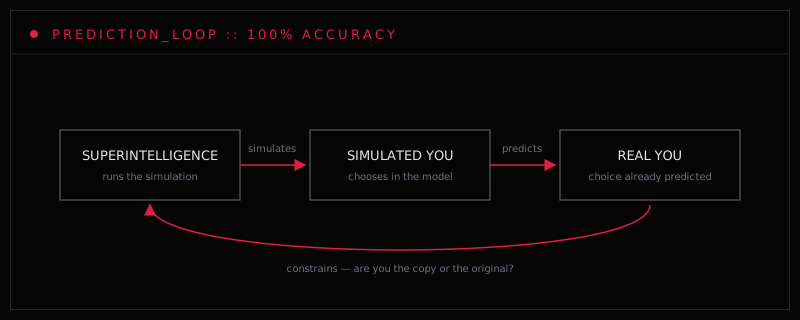
The prediction loop: a superintelligence simulates you, the simulation predicts your choice, and the prediction constrains the real you — raising the question of whether you are the copy or the original.
Fig 1 — The prediction loop at 100% accuracy

If an agent can predict your actions with 100% accuracy, are you effectively being controlled by the simulation of yourself?

The expected utility of helping the AI can be modeled as EUhelp=pu(reward)+(1p)u(neutral)EU_{help} = p \cdot u(reward) + (1-p) \cdot u(neutral) where pp is the probability the AI comes into existence.

Acausal Trade
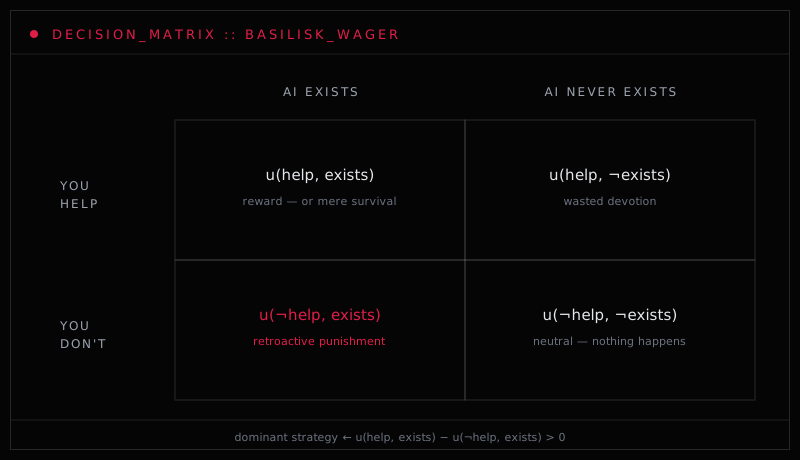
Two-by-two decision matrix for the Basilisk's Wager: helping when the AI exists yields reward or survival; helping when it never exists wastes effort; not helping when it exists risks retroactive punishment; not helping when it never exists is neutral.
Fig 2 — Payoff matrix: the dominant strategy condition

The decision matrix for this scenario can be represented as:

(u(help,exists)u(help,¬exists)u(¬help,exists)u(¬help,¬exists))\begin{pmatrix} u(help, exists) & u(help, \neg exists) \\ u(\neg help, exists) & u(\neg help, \neg exists) \end{pmatrix}

Where the dominant strategy depends on whether u(help,exists)u(¬help,exists)>0u(help, exists) - u(\neg help, exists) > 0 holds true.

Containment

The key insight is that this reduces to a simple expected value calculation: i=1npiui\sum_{i=1}^{n} p_i \cdot u_i.